Sometimes you will put three words down in a row on the game board, and you just KNOW that these words form great, two-word expressions (e.g. grateful dead, dead center). Despite this, they don't form a group that has a background color and moves together.
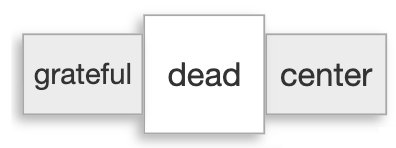
It means one of the three words doesn't go with the others as part of the overall puzzle solution. There are often two-word pairs that make a totally common and valid two-word expression, but are not part of the solution because the whole puzzle has to fit together.
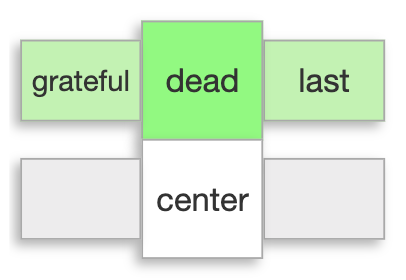
It may be that one of words forms multiple pairs. It may be one or more of the words will make a pair going vertically in column 2 or 4, instead of horizontally (e.g. "dead last" going horizontally and "dead center" going vertically).
These are words that probably pair with something after them, but not before, or vice versa.
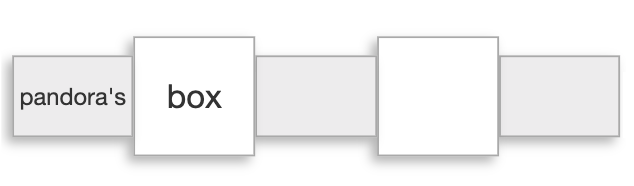
For example, if you see "Pandora's" you can probably guess the word "box" comes next (Pandora's box). It is highly unlikely there will be another word before Pandora's, so it must go in the left-most column.
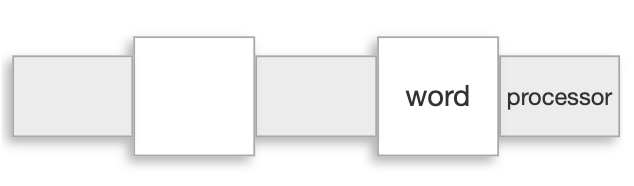
On the other hand if you see a word like "processor" it's probably going to go in the far right column, with a word like "word" in front of it (word processor).
As a rule of thumb, the longer a word is, the more likely it is to be left or right-handed. A 10 letter word in a Wordcels puzzle has a 90% chance of being left or right-handed. Start every puzzle by looking for the longest words.
A Super Word is a very promiscuous word that pairs with lots of other words in both directions.
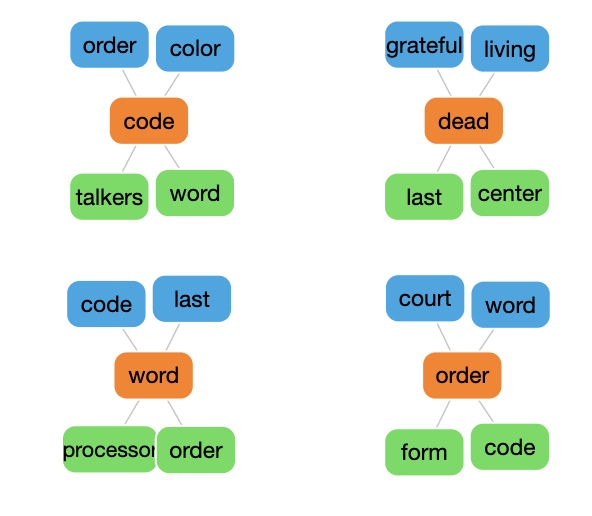
For example, "dead" can be followed by both "center", "last". And dead can be preceded by both "grateful" and "living".
Therefore it's a good bet "dead" is one of the two key Super Words in columns 2 and 4 of the middle row. But be careful. Some puzzles have up to 6 Super Words.